Three-year-olds are often eager to copy what the grown-ups around them are doing. They want to carry, pour, wipe, sort, and be part of whatever is happening. That makes this a great age to introduce a few simple household responsibilities.
The best chores for 3-year-olds are short, safe, and easy to understand. At this age, the goal is not a perfectly clean room or a flawlessly folded towel. The goal is to help your child practice following a routine, taking care of their belongings, and contributing to family life.
The American Academy of Child and Adolescent Psychiatry notes that children can begin participating in chores as early as age 3. It recommends small, manageable tasks, consistent routines, clear expectations, and positive feedback. Every child develops at a different pace, so choose tasks based on your child’s abilities and supervise as needed.
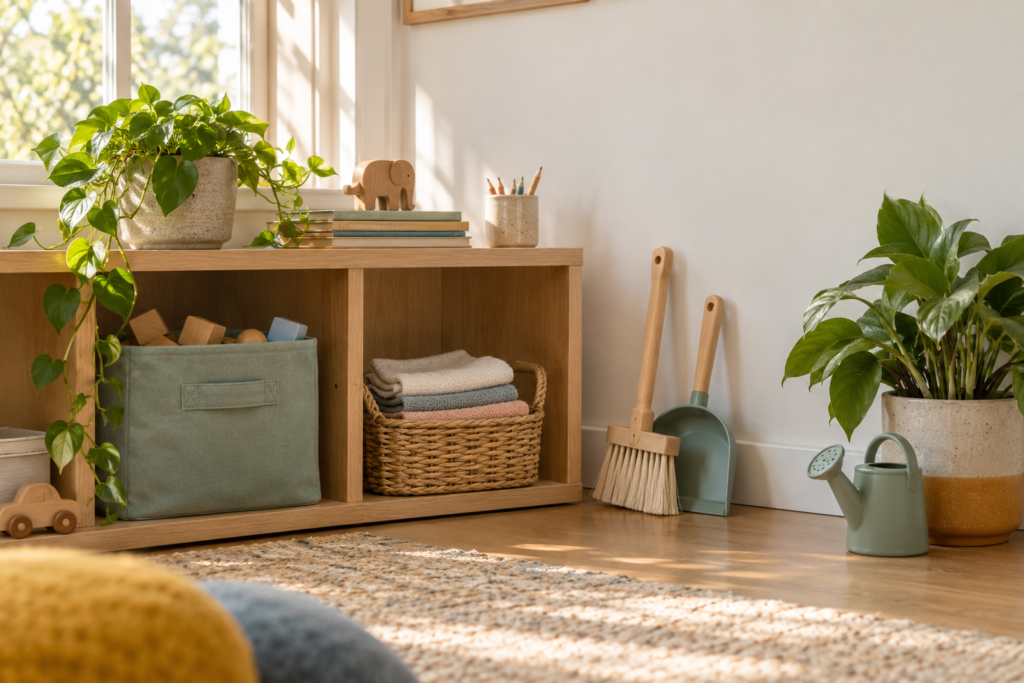
What Chores Can a 3-Year-Old Do?
Most 3-year-olds can help with simple one- or two-step jobs. Tasks work best when they use lightweight, unbreakable items and do not involve sharp objects, chemicals, hot surfaces, heavy loads, or unsupervised pet care.
Here are 21 practical chores to try.
Bedroom and Playroom Chores
-
Put toys in a bin. Start with one category, such as blocks, stuffed animals, or toy cars, instead of asking your child to clean the entire room.
-
Return books to a low shelf. Show your child where the books belong and help them line up a few at a time.
-
Put dirty clothes in the hamper. This is an easy daily task that can become part of the bedtime or changing routine.
-
Place pajamas under a pillow. If the pajamas will be worn again, give your child one consistent place to put them.
-
Help make the bed. A 3-year-old can pull up a blanket, place a pillow near the top, or arrange stuffed animals. It does not need to look perfect.
-
Choose clothes for the next day. Offer two appropriate options and let your child place the chosen outfit in a designated spot.
Laundry Chores
-
Match socks. Use a small group of clearly different socks at first. Matching colors and patterns turns laundry into a simple sorting activity.
-
Fold washcloths. Washcloths are small and forgiving. Demonstrate folding one in half and let your child practice.
-
Sort laundry by person or color. Ask your child to make a pile for each family member or separate light and dark items with your help.
-
Carry lightweight clothes to a drawer. Give your child a small stack of pajamas, socks, or underwear to put away.
Kitchen and Mealtime Chores
-
Place napkins on the table. This is a safe, simple way to involve a preschooler in setting the table.
-
Carry an unbreakable cup or plate to the table. Use lightweight plastic or other child-safe dishes and supervise the trip.
-
Put safe utensils away. After removing knives and other sharp items, let your child sort spoons or other safe utensils into the correct compartments.
-
Wipe a small spill. Keep a cloth or paper towel within reach and show your child how to blot or wipe a child-safe spill.
-
Help put groceries away. A 3-year-old can carry lightweight pantry items, paper products, or produce to a low shelf with guidance.
-
Throw away their own trash. Ask your child to place a napkin, wrapper, or other safe item in an accessible trash can.
Simple Cleaning Chores
-
Dust a low surface. Give your child a dry microfiber cloth and choose a safe, uncluttered surface away from breakable objects.
-
Wipe the table. After meals, your child can use a damp cloth on a small section of the table while you finish the rest.
-
Use a child-size broom. Sweeping crumbs into a general area is enough at this age. You can handle the final dustpan step.
-
Put shoes in their designated spot. A basket, mat, or low shelf makes it easy for a child to see where the shoes belong.
-
Help water a plant. Use a small cup or child-size watering can and measure the water beforehand to prevent overwatering.
If your preschooler is ready for slightly longer routines or is approaching their next birthday, explore these chores for 4-year-olds for the next step in independence.
How Many Chores Should a 3-Year-Old Have?
Start with one or two regular chores rather than a long list. A simple routine might be putting toys away before dinner and placing dirty clothes in the hamper before bed.
Once those jobs feel familiar, add another small responsibility. A long chart can overwhelm a young child, while a short routine gives them repeated opportunities to succeed.
The chores also do not need to be completed independently. At age 3, working beside a parent is often the most effective way to learn. You might hold the toy bin while your child collects blocks, fold one washcloth while they copy you, or wipe the opposite half of the table.
How to Make Chores Easier for a 3-Year-Old
Use one clear direction at a time
“Put the blocks in this bin” is easier to follow than “Clean your room.” Be specific about what your child should do and where each item belongs.
Connect chores to an existing routine
Attach the task to something that already happens every day. Toys can be put away before dinner, clothes can go in the hamper before bath time, and napkins can go on the table before a meal.
If your household schedule changes from day to day, the free Family Schedule Planner can help you organize recurring family routines in one place.
Make the environment child-friendly
Use open bins, low hooks, picture labels, small cleaning cloths, and lightweight tools. A task is much easier when your child can reach the supplies and clearly see where things belong.
Demonstrate before expecting independence
Show the chore slowly, complete it together, and then let your child try. Three-year-olds may need the same demonstration many times. That repetition is part of learning.
Praise effort rather than perfection
Try specific encouragement such as, “You put every block in the bin,” or “You remembered where your shoes belong.” The American Academy of Pediatrics’ HealthyChildren.org recommends praising effort and treating chores as a learning process instead of expecting perfect results.
Keep the routine short
Many chores for 3-year-olds should take only a few minutes. Stop before the job becomes an extended battle. A small task completed consistently is more useful than a complicated routine that no one wants to repeat.
Should a 3-Year-Old Use a Chore Chart?
A very simple chore chart can work well for a 3-year-old, especially when it acts as a visual reminder. Limit the chart to a few familiar tasks and use short labels or pictures your child recognizes.
The chart should make the routine easier to understand, not create pressure. Checking a box, adding a sticker, or celebrating a completed row can give a young child a satisfying sense of progress.
Use the free Kid Chore Chart Generator to add your child’s name, choose a few manageable tasks, and print a personalized chart for your routine.
Do 3-Year-Olds Need Rewards for Chores?
You do not need to pay a 3-year-old for every household task. At this age, praise, attention, stickers, choosing a song, or celebrating the finished job may be enough.
Some families like a small reward system, while others treat basic chores as part of belonging to the family. Either approach can work. Keep the expectations simple and avoid turning every helpful action into a negotiation.
Chore Safety for Preschoolers
Always match the chore to your individual child and supervise closely. Three-year-olds should not handle household cleaners, knives, glass dishes, hot appliances, heavy objects, or tasks involving heights. Keep small choking hazards, medications, pet food, and unsafe laundry products out of reach.
If a chore consistently causes frustration, simplify it or try a different task. A child may be ready for one responsibility but not another. The purpose is to build skills and confidence gradually.
A Simple Starter Routine
If you are not sure where to begin, try this three-task routine:
- Morning: Put pajamas in their designated spot.
- Before dinner: Put toys in one bin.
- Before bed: Put dirty clothes in the hamper.
Practice the same routine for a week or two before adding anything new. With clear directions, patient demonstrations, and realistic expectations, chores can become a positive part of your 3-year-old’s day—and a first step toward greater independence.
As your child grows, explore our guides to chores for 4-year-olds and chores for 5-year-olds for age-appropriate next steps.
Frequently Asked Questions
Is age 3 too young for chores?
No. Many 3-year-olds can participate in small household tasks with supervision. Start with safe, manageable jobs and expect to work alongside your child while they learn.
What is the easiest chore for a 3-year-old?
Putting toys in a bin, placing dirty clothes in a hamper, carrying napkins to the table, and returning shoes to a designated spot are good starter chores.
What if my 3-year-old refuses to do chores?
Make the task smaller, give one clear direction, offer limited choices, and connect the job to a consistent routine. Avoid expecting perfection or turning every chore into a prolonged conflict.
How long should chores take at this age?
Most chores should take only a few minutes. Short, repeatable tasks are usually easier for a preschooler to understand and complete consistently.